yes, and fuck it!!
an ode to 2020 netflix special(s) "middleditch & schwartz"

it is a truth universally acknowledged that nothing is more painful to watch than bad improv comedy. fortunately, in my own life, i have somehow escaped that torturous experience1, and i imagine that that’s actually the case for most people. improv hasn’t really gone mainstream outside of the comedy community2—unlike its cousin, stand-up comedy (which i have seen a lot of bad renditions of). i can think of plenty of stand-up performers who have established name brand recognition through their stand-up alone: dave chappelle, hannah gadsby, john mulaney, ali wong3.
these latter comedians amassed large followings through their widely distributed netflix specials, and therein lies the reason for improv’s relative obscurity, i think: while both stand-up and improv depend on the unpredictable energy of live theater, a good stand-up routine still tends to be scripted4 and can therefore reach a more or less “final” state in which it can be filmed and then distributed as a finished product5. in contrast, improv is specifically meant to be ephemeral and singular; it would be impossible to repeat the same performance twice, and the spontaneous format lends itself a lot less obviously to distribution.
moreover, taping improv threatens to undermine the main appeal of watching improv, namely the unpredictable excitement that anything can happen. when you’re watching a taped performance, “anything” has already happened. moreover, practically, if you’re following an improv troupe, you couldn’t necessarily predict the best show to film beforehand: unlike a standup comedian who refines their routine throughout their tour, a later improv show doesn’t necessarily depend on an earlier one, so no show is guaranteed to be more refined than the one that came before or after.
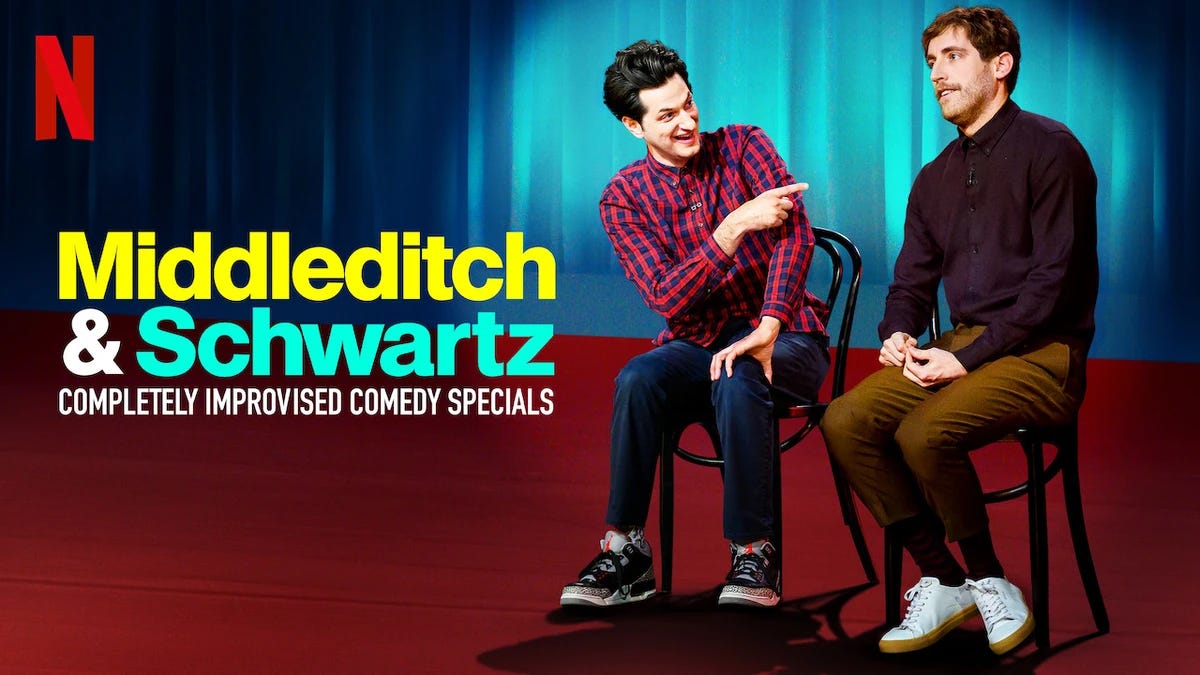
that being said, there is a widely accessible improv special currently available on netflix. middleditch & schwartz features performers ben schwartz and thomas middleditch, neither of whom is known specifically for their improv: ben schwartz broke out as supporting character jean-ralphio saperstein on the nbc sitcom parks and rec; thomas middleditch is best known for his lead role in the hbo show silicon valley. the special consists of three episodes (“parking lot wedding,” “law school magic,” and “dream job”), where the performers ask each audience a question (something they’re dreading, something they’re excited about, etc), and plumb a particular participant’s response for an ~hour-long show improvised entirely from that person’s prompt.
right off the bat, i should say that middleditch & schwartz has not been renewed for another season, despite the performers’ seeming interest in continuing the show at the time—most likely because thomas middleditch was soft-canceled for sex crimes in 2021 and has quietly gone the way of 2019 aziz ansari (minus the nascent comeback efforts). from what i can tell, this is mostly for the best, and i am not interested in issuing any referendums on the state of thomas middleditch’s career; when i discuss his acting, i am not saying that he should be reintegrated into hollywood / society writ large—i am literally just interested in talking about his work in this television special.
since (presumably) breaking up with thomas middleditch, ben schwartz has not put out another improv special, but he has continued to tour as “ben schwartz and friends” (with an all-time b-list-comedy repertoire: colton dunn, drew tarver, eugene cordero, brandon scott jones—a real who’s-who of beloved sitcom guest stars).
because i continue to spend upwards of an hour a day on youtube, my youtube algorithm has started dredging up the clips he’s been posting of his tour for me: rich club, real estate leprechaun, dungeons and dragons. over the last few weeks, while watching these clips, i’ve found myself missing the anarchic excitement of the bits in middleditch & schwartz. and, to be fair: you cannot compare a three-minute clip to a one-hour special, especially not when the latter was produced with netflix money (and the premium camera setup allows you to better follow the nuances of the performances, more on this later)—so, not having seen a full schwartz and friends show myself, i am not going to judge whether the new tour is objectively better or worse than the netflix special.
still, i think the improv comedy in these new clips helped underscore what i still love so much about middleditch & schwartz, and, by contrast, what good comedy is all about. for example: over the weekend, while folding laundry, i watched schwartz’s recent four-minute clip, “song in the key of c,”, which is improvised around the prompt of “christian youth pastor.” this sketch6 follows a pretty simple and straightforward structure in which each performer repeats the same comedic beats as the previous person and performs their own song via the “the key of” motif: they compose a song in a specific key with religious significance (the first being the “key of C,” C for christ), and specifically not in another key (not, for example, “the key of D, D for david,” the worst disciple), which, when they explain it, makes them verklempt (“i just can’t get over what he did to the lord”) and prompts everyone to comfort them.
for contrast, the first three minutes of the final episode of middleditch & schwartz (“dream job”) are downright anarchic (youtube):
with the prompt of “job interview,” thomas middleditch plays a computer prompting ben schwartz to answer interview questions for an internship.
the first comedic turn comes just 30 seconds into the sketch, where schwartz “reads” the imaginary interview question in front of him out loud (“why do i want to be a photographer?”) and middleditch only gives him five seconds to answer.
put on the spot, schwartz flubs the question, and they proceed with the format with schwartz “reading” the next question.
immediately after schwartz reads the question, however, middleditch throws him another curveball at 0:49, by suddenly changing the time to respond to an arbitrary “12 seconds” instead.
already, we’re off to the comedic races, but then middleditch suddenly intervenes in the format by announcing that the next question will be multiple-choice, and there’s a small moment here when you can see schwartz make a “what the fuck” face because he’s been making up the questions so far—
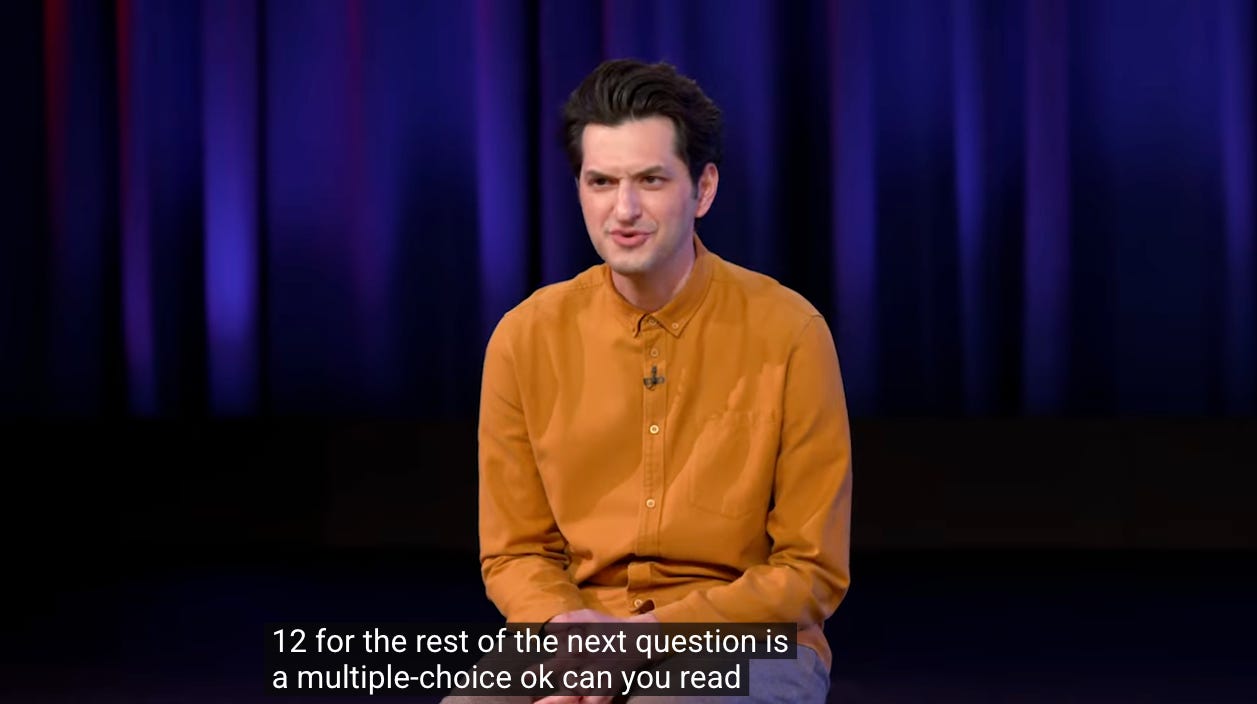
—and he goes, okay, can you read it? to which middleditch robotically responds, “i will read the question,” as if he was always going to say that.
there’s a clear comedic dynamic here—schwartz as the naive applicant flailing through the interview, middleditch as an impersonal computer system relentlessly forcing him to answer increasingly strange prompts—but, even just ~1 minute in, we observe that the performers spontaneously initiate a small but significant shift in the dynamic, with middleditch now taking over the narrative responsibility of making up the interview questions.
after the weird multiple choice question, middleditch has to up the ante, and he stumbles into prompting schwartz to answer a “visual skills challenge”—and you can see him (in the background) making his own “what the fuck” moment as he’s saying the words out loud.
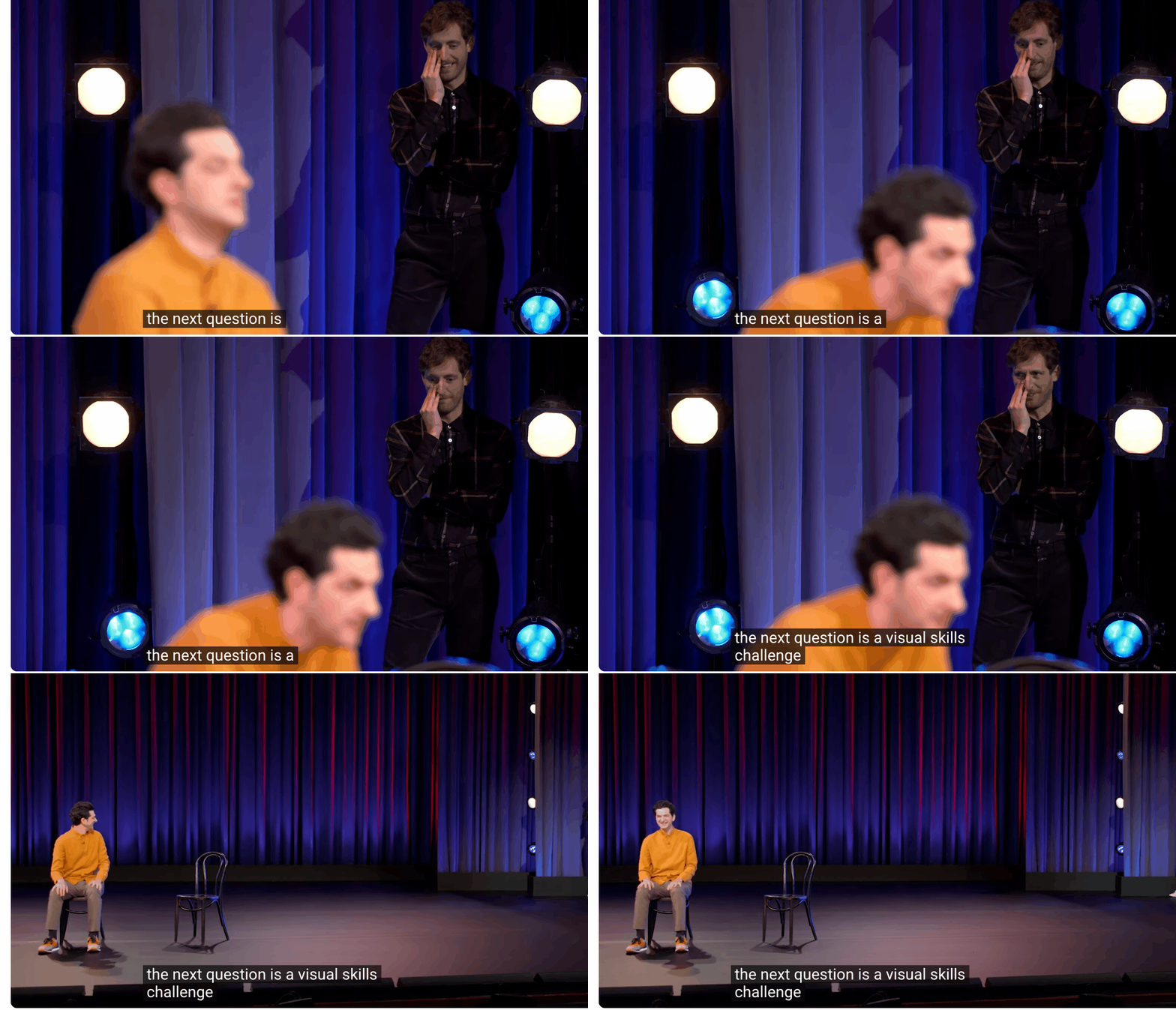
which causes schwartz to crack up and say—both in character and out—“i don’t understand what a visual skills—”
to which middleditch responds with an equally random prompt: embody a gazelle. bonus points for showing that you know what it eats and what it is stalked and hunted by.
to which schwartz incredulously repeats (again, both in-character and out-—he’s genuinely baffled), “and what it is hunted by?”
to which middleditch says, “correct.”
immediately, schwartz catches this slip—either intentionally or not, middleditch’s reply has broken the rules he has established about the computer persona not being able to interact with the applicant—and he exclaims, “so you can hear me!”
this seems to fluster middleditch (both the character / the performer), which schwartz takes advantage of by trying to force middleditch to enact the gazelle performance first, by asking the computer to show him, on the screen, a picture of a gazelle, “so that i can copy it, please.”
to which middleditch stubbornly refuses to move and says, here is a picture of a gazelle. look at the screen.
to which schwartz says, with amused resignation, “alright, great, thank you, asshole.”
in just these few minutes, there are already many formal elements that work much better for me. first, because middleditch & schwartz consists of only two performers, everything they do is in direct response to each other. already, we can see how this form might affect the content of the sketch: whereas the group scene of “the key of C” might need to move slowly to afford each performer time to iterate upon the central premise (if you change the scene too quickly, there’s a good chance you’ll upend someone else’s plans), in about the same amount of time, middleditch and schwartz are able to escalate the narrative much more dramatically through a rapid series of increasingly deranged comedic dares—throwing out impossible setups that nonetheless call for punchlines.
along those lines, it’s notable that, whereas the performers in the “the key of C” sketch advance the story together as a group by continually returning to the same premise and re-enacting it, the two performers of middleditch & schwartz are constantly throwing each other—and themselves—for a loop: in three brisk minutes, the premise changes from “self-administered rushed computer interview” (which is already funny) to a meta-narrative contest of wills between schwartz and middleditch to see who’s going to debase themselves in front of the audience first.
famously, the first rule of improv is to follow the “yes, and” principle: when a fellow performer makes a creative choice, you as an improviser should internalize their choice (“yes”) and build upon it in some way (“and”), rather than undermine their performance or change the scene entirely. by following the “yes, and” principle, a group of performers can push the story forward, sustain the immersive dream of a coherent and consistent narrative, and encourage each other to take creative risks that might create openings for even zanier comedic avenues.
that middleditch and schwartz are constantly challenging each other’s actions and pointing out inconsistencies in their performances would seem to violate this central principle. if they’re obviously fucking with each other, it should undercut the constructive ethos of improv comedy—and yet the friction between them as performers is itself deeply funny, and only enhances the comedic performance.
so how does that work? first, the obvious answer: middleditch and schwartz have absolutely incredible chemistry on stage—just white-hot—and it makes you want to watch them forever. even in this scene, you can see how each performer plays to his strengths:
ben schwartz is a gorgeous improviser: flexible, wide-eyed, and energetic; good-natured, game for anything, and effortlessly good at physical comedy.
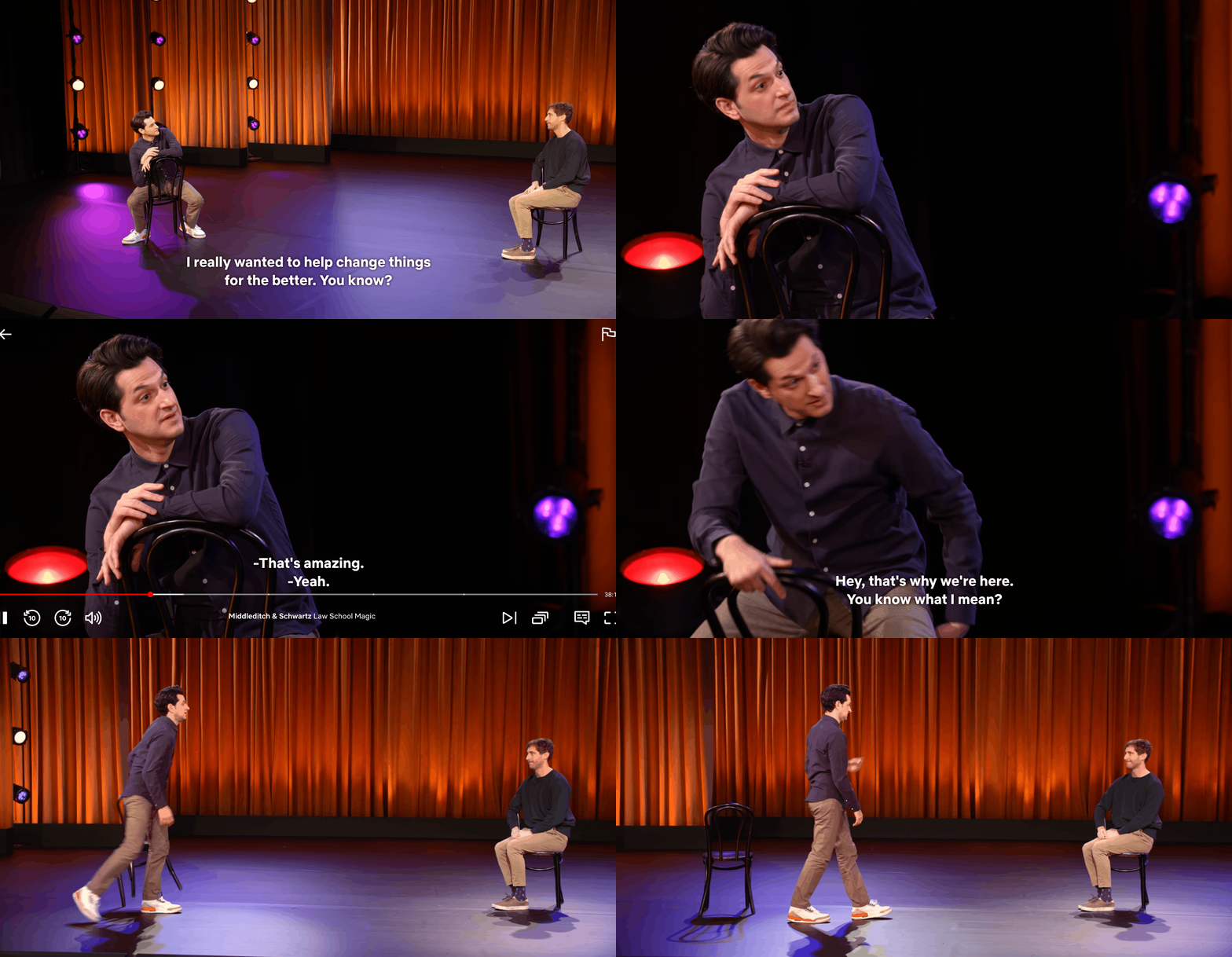
i keep thinking about this one scene in another episode, where he plays a “too cool for school” teacher who sits like this (a predictable joke, imo)—
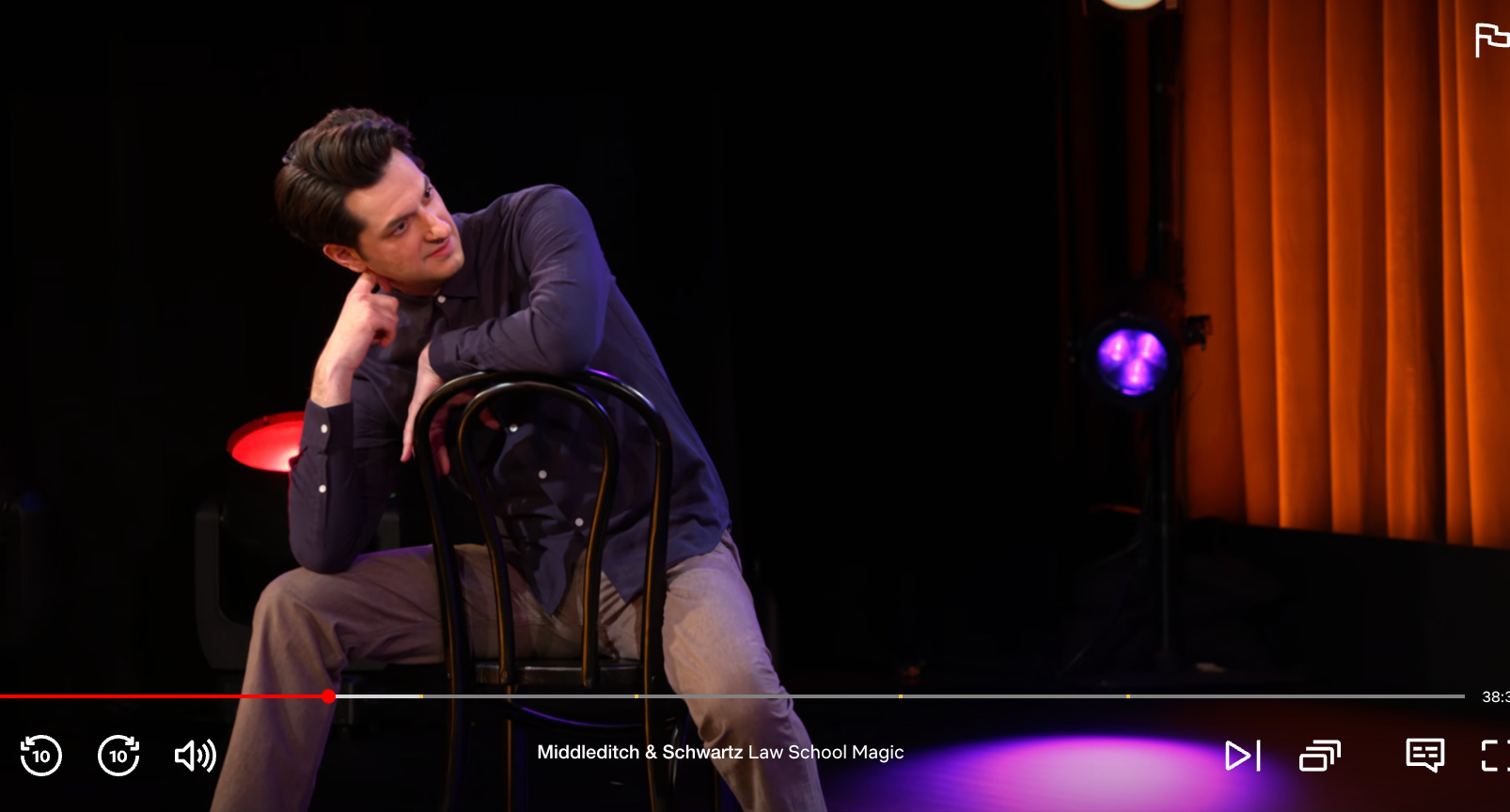
—but gets up from the chair by scooping it smoothly under his legs—like dribbling a basketball—without missing a single beat:
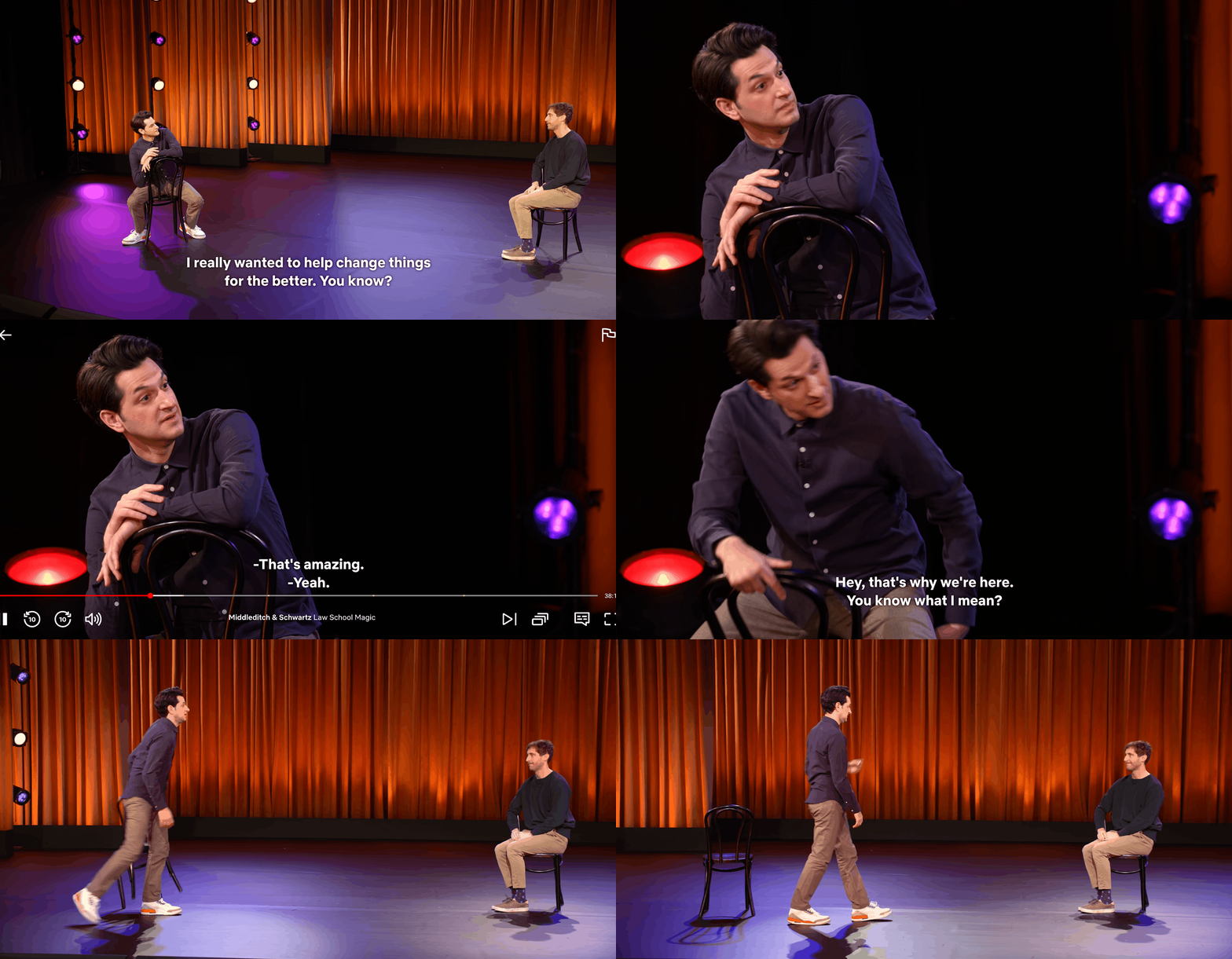
some people in the audience actually start clapping when he does this
in comparison, thomas middleditch is more exacting and mean, better at subtle acting choices (accent work, micro-gestures that immediately characterize the entire person he’s playing), and is also the one who’s most likely to stop what they’re doing to clarify the technical details of a scene or the story.
see this incredible scene where he recaps the convoluted plotline of the second episode with great exasperation.
however, it’s too easy to say that these two performers work well together in their dissimilarities because they complement each other’s differences. rather, it’s more compelling how these differences are not always productive for the cohesion of the show—it’s not as if schwartz plays all the ingenues and the dummies, middleditch the nerds and the freaks.
instead, each person often takes up roles that the other had previously been playing, for the sake of the scene—and, in many cases, performing the character in a way that directly contradicts what the previous performer had been doing. for example: in the second episode, both middleditch and schwartz take turns being a character named stanley, whose accent slides very dramatically around the european continent depending on who’s playing him.
the inconsistent accent work culminates in this incredible exchange, where middleditch (the original stanley) takes over the character again:
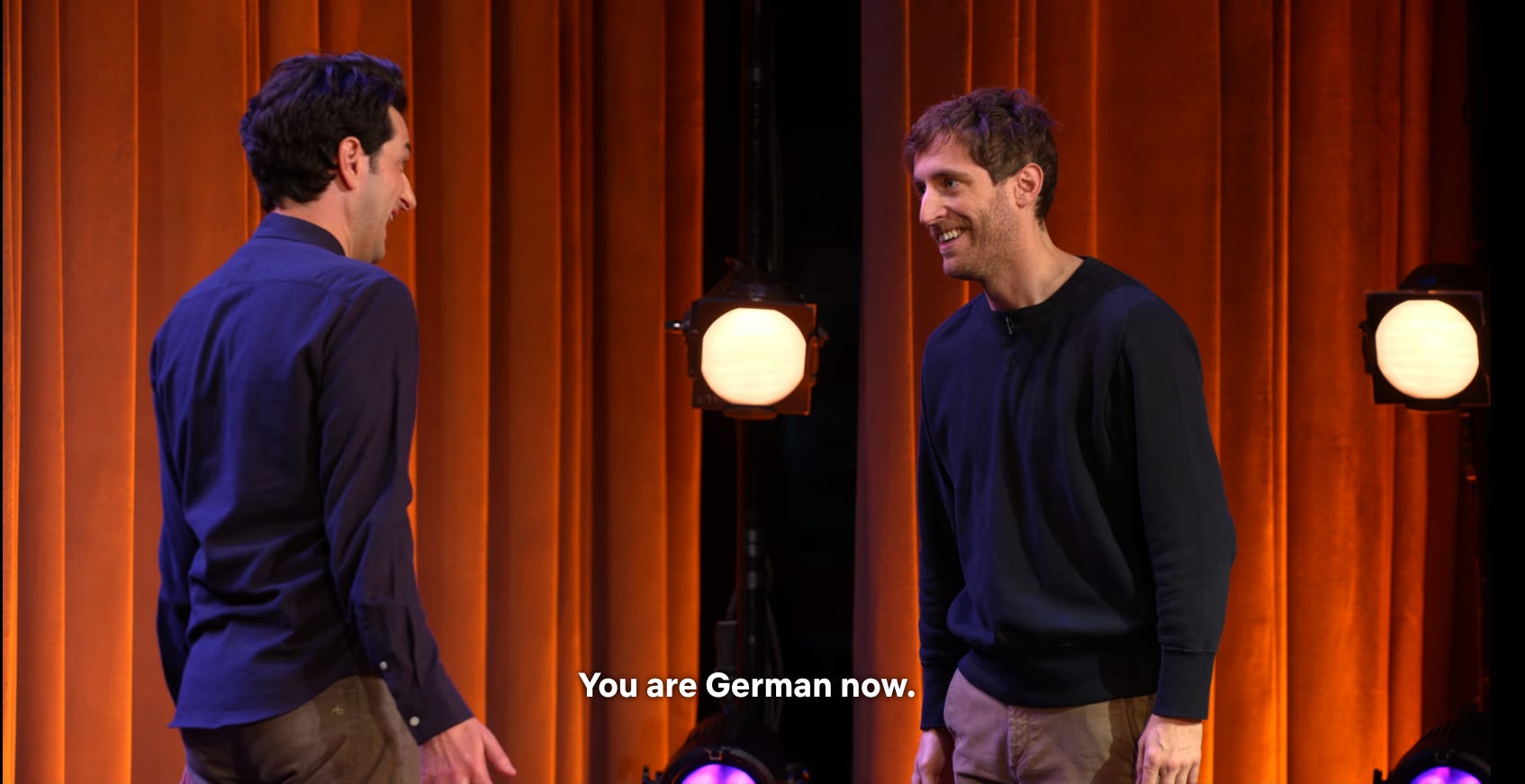
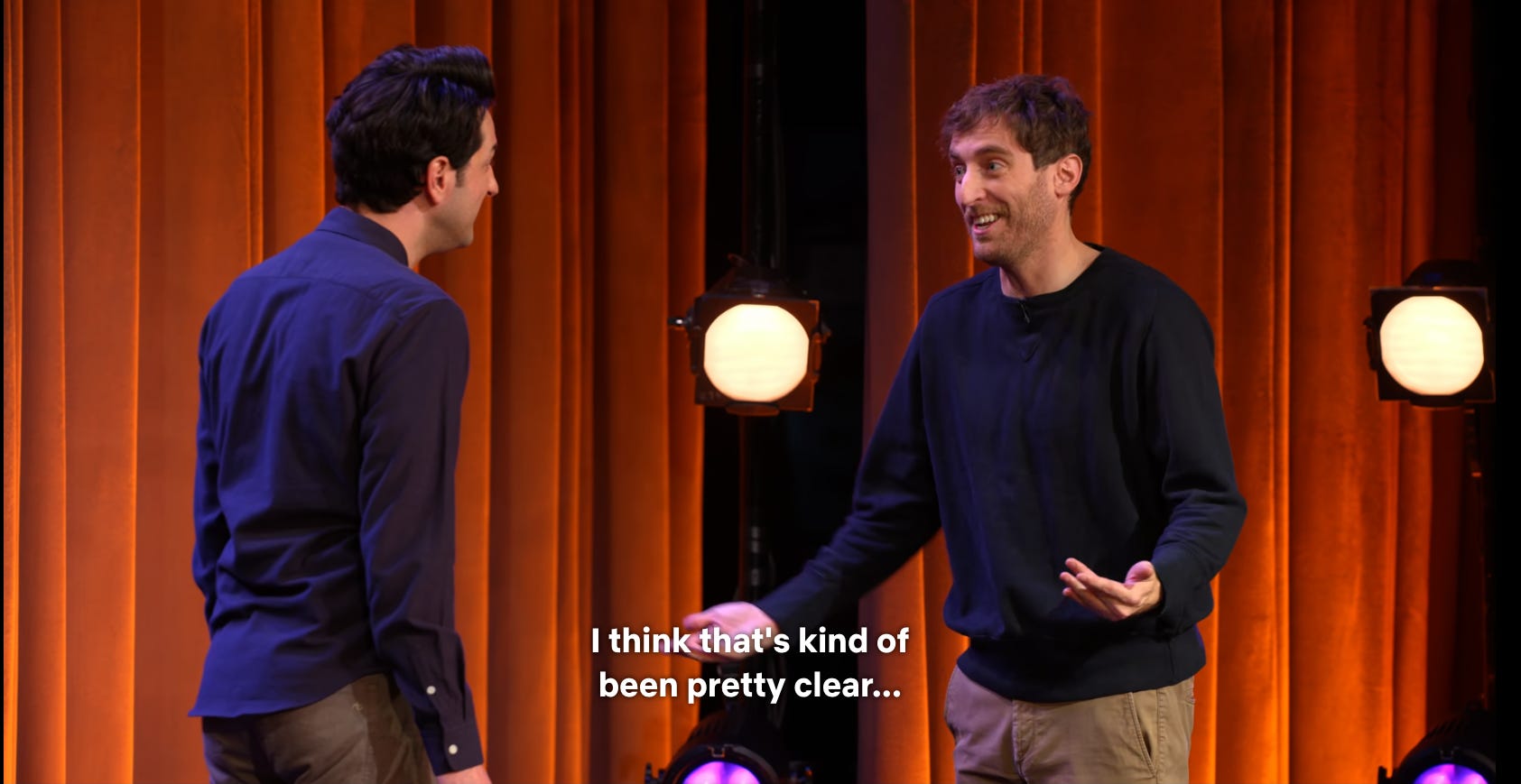
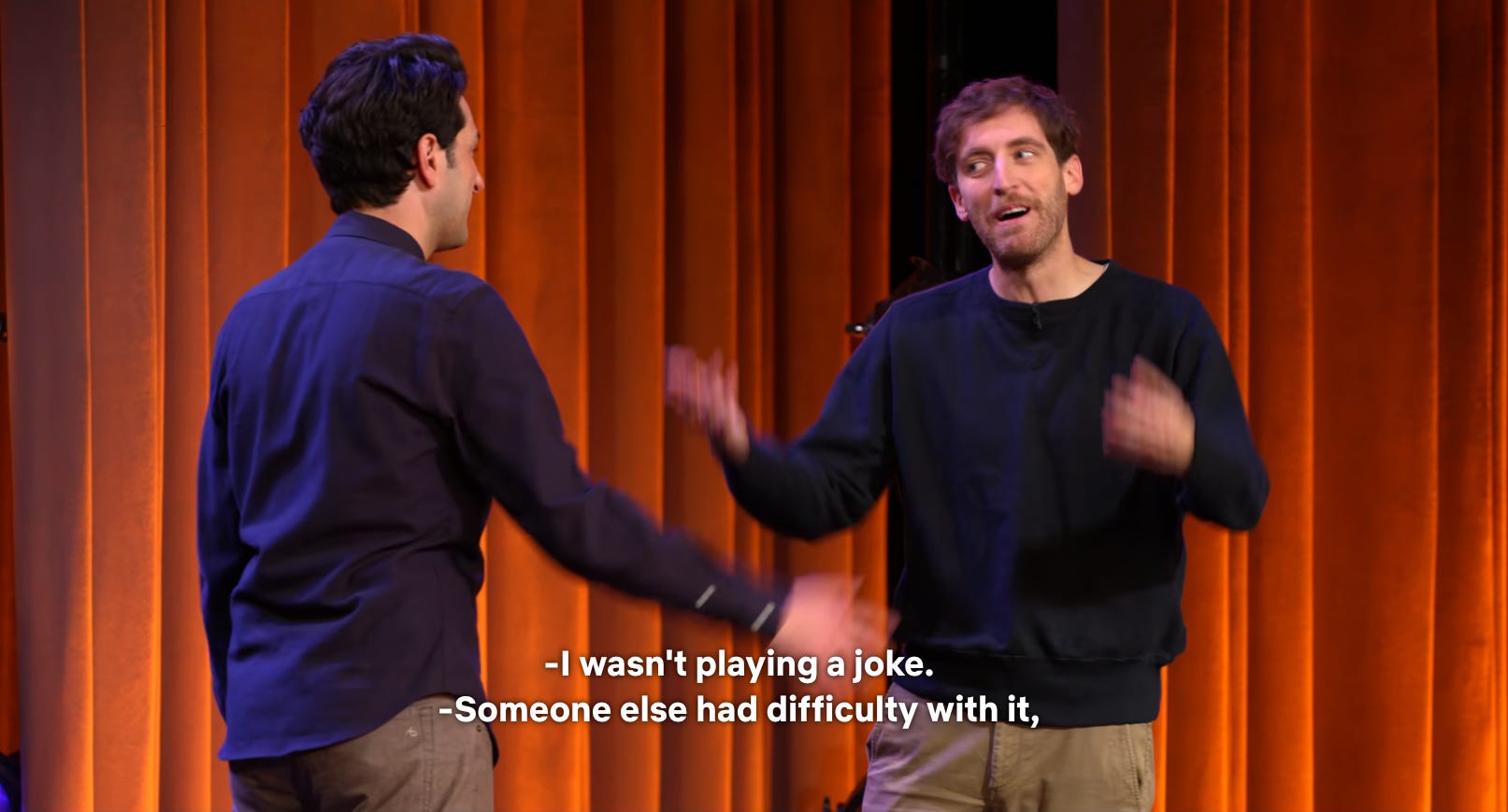
so how does that work? why is that so funny? how do those inconsistencies not undermine our investment in the narrative?
first, we can analyze the middleditch and schwartz dynamic dialectically in that, by making divergent choices, each performer pushes the story forward in his own way, and each show ultimately concludes in a creative synthesis that incorporates both of their choices into the overall narrative.
to that point: across the three episodes, the stories do end up coming together in really satisfying ways—perfect callbacks and what this letterboxd user describes as the greatest plot twist of all time. in other words, in each episode, they actually manage to create a good story.
thus, given that the narrative comes together in the end, that middleditch and schwartz challenge each other only conversely reinforces how well they work together as improvisers and the superhuman level of trust between them.
to return to the gazelle example: in the opening clip, middleditch is fucking with schwartz by forcing him to embody the gazelle first. however, ~10 minutes later, when middleditch enters as a new character, he’s prompted to embody the gazelle himself—and commits without any hesitation, maybe even harder than schwartz did. in doing so, he pointedly refuses the easy way out (to leave his partner hanging) and throws himself into a challenge that he himself created, for the both of them to handle together.
in that sense, these two performers are only able to challenge each other because of how much they trust each other as improvisers. they are able to question each other’s choices because they know they’re going to move forward anyways; they are able to fuck with each other because they have each other’s backs.
and, as audience members, we realize that these two performers trust each other specifically because that trust is tested over and over again; we understand that they work well together specifically because the story ultimately comes together even though we see how easily it could fall apart.
so the appeal of this improvised special lies not just in the specific story that these performers are telling, but also in the performative struggle of creating the narrative in the first place—and, in order to figure out how to create this narrative in real-time, each performer has to figure it out in the performance itself.
for example, in “dream job,” if schwartz wants to ask middleditch to think of the next question in the job interview, he can’t do it metatextually; his character has to ask middleditch’s character to tell him what it is—which creates an absurd image of an interviewee asking a computer to read a question he can obviously read himself.
then, the fun comes not in spite of, but from the push-and-pull within this creative negotiation, which necessarily fractures the narrative while building it—not because bad performances actually trump good ones7, but because these particular performers turn those mistakes and failures into the bit itself.
folding these discrepancies and these meta-textual considerations into the show then allows the performers to push the comedic act into a wonderfully weird formal experiment that dramatizes the act of storytelling, where you can watch how each performer makes choices in real time. in that respect, the distinctions between the two performers speak to the choices that each is making; e.g., if stanley’s accent is not exactly the same across performers, it draws your attention to the work that goes into performing an accent and forces you to think about how these performers are choosing to define the character of stanley.
of course, in doing so, the special threatens to challenge the audience’s suspension of disbelief, but somehow that’s another joke: suspension of disbelief is inherently absurd! it is unbelievable that we are watching the show and pretending that these comedians are actually playing a wide range of characters with a whole array of mimed props—when they’re really just doing silly voices on a spare stage—and it is objectively insane for me to feel so invested and immersed in these imaginary contrivances.
as a result, narrative itself becomes the joke: that middleditch and schwartz are trying to do this show in the first place is something we can laugh at—not at them, but with them, as they themselves start laughing incredulously at the arbitrary challenges they’ve constrained themselves with.8
in the end, this is a silly comedy special, but the comedy is in the narrative, and so the special takes it seriously and tries to do a good job—hence the arguing over accents, hence the technical questions about how many people are actually in the room. and, for all of the goofs in the special (and maybe because of them), middleditch & schwartz makes it incredibly obvious that telling a story on the spot is extremely effortful. when middleditch is trying to come up with another interview question off the top of his head, or when schwartz starts hiding behind an imaginary door, you can almost see them using all of their mental faculties to figure out what they should do next, and how they should resolve all the threads in the story, and what would be not only interesting but funny and satisfying—a tall order even for a scripted story.
and, well, once again, that’s inherently funny: the stupid slapstick comedy, juxtaposed against the tremendous creative effort of bringing said comedy to life, from the physical exertion of sprinting across the stage at a moment’s notice to the mental strain of expositing extemporaneously about the nuances of contract law or meticulously outlining who is switching bodies with whom in a mystical journalist body-swap spell.
in short, this improv special situates its comedy on three levels: the textual jokes that the characters tell (“you have 12 seconds to answer”), the subtextual fourth-wall breaks that then create room for textual absurdity (middleditch responding to schwartz, which means actually the computer has been listening to the candidate the whole time), and the meta-textual absurdity of both performers (and the audience) pretending that the story is a coherent entity while it is obvious that these two guys are frantically constructing it from random bits and pieces on the fly.
in theory, the best improv entails experienced performers overcoming the limitations of the form and achieving a perfect mind-meld in order to create a completely cohesive and impressively consistent story, the kind that leaves you, as an audience member, going like, no way, they definitely planned that ahead of time, how did they think of that on the spot?
in contrast, middleditch & schwartz reveals that the best comedy—the best art, even—emerges not from continuity, but from discontinuity: when one performer steps just out of reach of the other, or throws the other something they’re not prepared to handle. moreover, in middleditch & schwartz, the gap between one person and another can become the bit, the juxtaposition between a silly work and the serious effort required to produce it.
in other words, good improv is like a trust fall: you lean back and hope that the other person catches you. and it’s absolutely astounding if they do, when it turns out they miraculously had your back all along—but, sometimes, it’s funnier if the person doesn’t: if they decide to drop you, or if they sprint across the room mission impossible-style to catch you and end up tripping themselves, or if they’re not even around in the first place. you decide: the trust fall becomes a prat fall; the businessman slips on a banana peel; the clown eats shit with a grin.
the only improv show i can remember attending is my college improv troupe’s show at my freshman orientation, which could not have been good but could not have been bad because i don’t remember it at all.
yes, many famous comedians got their start specifically in improv (seth meyers, amy poehler, tina fey, kristen wiig, bill hader), but all became actually famous via scripted television projects (in this case, SNL).
off the top of my head…
ignoring the recent trend towards crowdwork specials, which i haven’t really watched and don’t care for.
much like a novel, in that respect: novels are never really done, but writers have to stop somewhere if they want to be published.
if i call an improvised show a “sketch,” will people yell at me, lmao
there’s another moment in the second episode where middleditch refers to a snickers bar that he’s got in his pocket, only for schwartz to hastily correct the reference to a generic “candy bar?” and that correction is completely ridiculous: improv is all about doing literally anything; it’s completely spontaneous—the world is your oyster, except for the absolute limitations of copyright law…